Leadership with Heart
Desert Foothills Leadership Academy (DFL) is a Signature Program of The Holland Center and a partnership with The Carefree-Cave Creek Chamber of Commerce. With an uptick in civic disengagement, passionate and skilled leaders are needed more than ever to make a difference in big or small ways. Once a month from March through November, DFL participants meet to explore business and civics topics that equip them with the skills, experiences, and networks needed to positively impact organizations in city government, business, nonprofit, and cultural sectors. Learn more at desertfoothillsleadership.org.
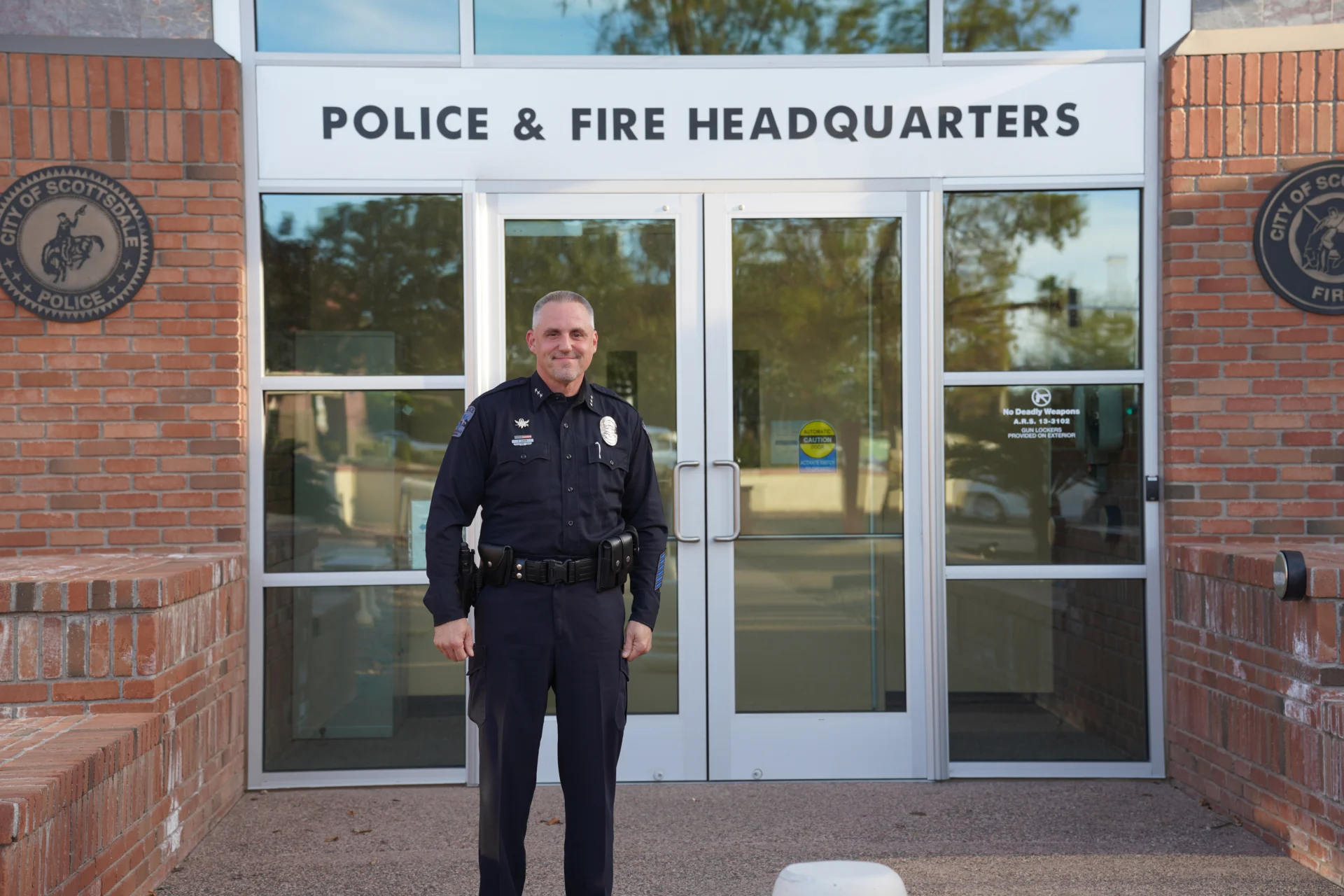
Richard "Rich" Slavin: Assistant Police Chief, Scottsdale Police, and regular presenter at DFL’s Public Safety day.
Some leadership begins with authority.
The kind Officer Rich Slavin teaches begins with the heart.
At The Holland Center’s Desert Foothills Leadership Academy (DFL), leadership isn’t about titles, rank, or position. It’s about responsibility to others — about choosing to serve, to listen, and to help people grow.
And it’s the same philosophy that guides Slavin — a veteran public safety leader whose message to DFL participants is simple, but powerful: leadership starts with caring for people.
A leader who starts with the heart
Slavin serves as Assistant Chief for the Scottsdale Police Department and has spent more than two decades in law enforcement from patrol to SWAT leadership, investigations, command roles, and training. He holds a master’s degree in organizational leadership, is a graduate of the FBI National Academy and FBI-LEEDA Command Leadership Training, and co-founded Advance Team Leadership Training, where he teaches leadership development across the country.
His focus is servant leadership — a model built on accountability, integrity, humility, and putting others before self.
“I present on the 4 Pillars of Leadership — which becomes your ‘why’... to lead and serve others with all your heart and soul operationally, administratively, politically, and strategically,” said Slavin.
“It’s about loving and serving because you want everyone to grow. That’s leadership.”
Lessons from public safety — for everyone
In policing, Slavin says, leadership can’t rely on rank alone. Trust, empathy, and accountability matter just as much in a patrol briefing as they do in a neighborhood meeting or a boardroom.
He sees that same need in both communities and businesses.
“Leadership development programs help people understand that leadership is not a title — but instead is a responsibility and a commitment to the service of others,” said Slavin. “At their best, these programs move individuals from being self-oriented recipients of others’ service to active contributors to their community.”
Through DFL, those ideas move beyond the law enforcement world and into civic life.
“Through the lens of the Four Pillars of Leadership — Operational, Administrative, Strategic and Political — these programs help participants see how their behavior, decisions, and attitudes influence the environment around them,” said Slavin. “Enlightened citizens are not simply informed; they are self-aware, empathetic, and intentional in how they engage with others... truly putting others before themselves.”
Building a legacy of healthy communities
Slavin believes leadership programs like DFL shape the culture of a community.
“Leadership programs should prioritize values and skills that shape culture, not just technical knowledge,” said Slavin.
“That includes self-awareness and emotional intelligence, because how we show up matters more than what we say; ethical decision-making, especially when outcomes are not clear or pressures are high; respectful communication and active listening, particularly with people who hold different views; service-based leadership, reinforcing that leadership exists to serve others; and accountability and ownership, understanding that trust is built through consistent behavior over time.
“These skills prepare participants to lead in families, workplaces, neighborhoods, and civic spaces, often without ever holding a formal position.”
For measuring the outcomes of leadership programs like DFL, Slavin believes success is seen in trust and behavior.
“From a law enforcement perspective, success is reflected in trust and understanding… from the broader community perspective, success shows up in behavioral change,” said Slavin. “Graduates [of leadership academies] become more engaged, more informed, and more invested in the well-being of others.”
Over time, those individual changes create something bigger.
“The collective impact is significant — and often underestimated,” said Slavin.
“Two hundred graduates [for example] represent a distributed network of cultural influencers across business, education, nonprofits, neighborhoods, and local government. Each graduate carries shared language, shared values, and a shared commitment to the community. Over time, this creates stronger informal leadership across sectors, healthier organizational and neighborhood cultures, more collaborative problem-solving, and increased civic engagement and volunteerism.
“This is how communities build prosperity — not just economically, but socially and culturally. Leadership programs create a legacy effect, where the influence of one cohort compounds year after year.”
Leadership and public safety
Slavin also draws a powerful connection between leadership and public safety.
“Public safety is deeply connected to how people relate to one another. Leadership programs improve safety by strengthening those relationships long before a crisis occurs,” said Slavin.
“Participants learn how to communicate rather than escalate, seek understanding rather than assume intent, and resolve conflict informally before it becomes formal or confrontational.
“Leadership programs also humanize institutions like law enforcement. When citizens understand the role, challenges, and values of policing — and officers better understand the community — trust grows.
“Communities with higher trust, stronger relationships, and shared responsibility experience fewer conflicts and respond more effectively when challenges arise. In that sense, leadership development is one of the most sustainable forms of prevention we have.”
-----
In Rich Slavin’s classroom, the lesson is clear: leadership is service, and service builds relationships. The same principles that guide public safety — empathy, accountability, humility, and care for others — are the very ones that help neighborhoods thrive and communities prosper.
When DFL graduates carry those values back into workplaces, civic groups, and everyday life, the impact doesn’t fade; it multiplies.
And that’s how a community grows stronger. Not through authority. But through people who choose to lead with heart.