From Disaster Recovery to Artful Renewal
In her former career in information technology, Josephine Wilt specialized in disaster recovery and business continuity — the person organizations relied on when the unthinkable happened. “If there was a national disaster, my kids knew that mom may not be coming home for a while,” said Josephine. Sept. 11 was one of the major events she worked through.
Today, Josephine still does recovery work.
Only now, it involves things like leather scraps, rusty cans, torn paper, and forgotten objects waiting for a second life.
Finding an artist she didn’t know was there
“When I first moved to Arizona, I was looking for something to do,” said Josephine. “At that time, I didn’t have an interest in art. But I decided to take a ‘torn paper collage’ class led by an artist named Althea Sassman. I was surprised that it interested me!”
That class unlocked something unexpected.
“It became the impetus to try using recycled materials for making art in my own way,” she said. “From then on, friends and family started to save recycled materials for me to use in my art. Jennifer Rosvall [Executive Director] from The Holland Center even saved a couch for me from Kiwanis Marketplace!”
That spark grew into a distinctive artistic voice rooted in Arizona itself.
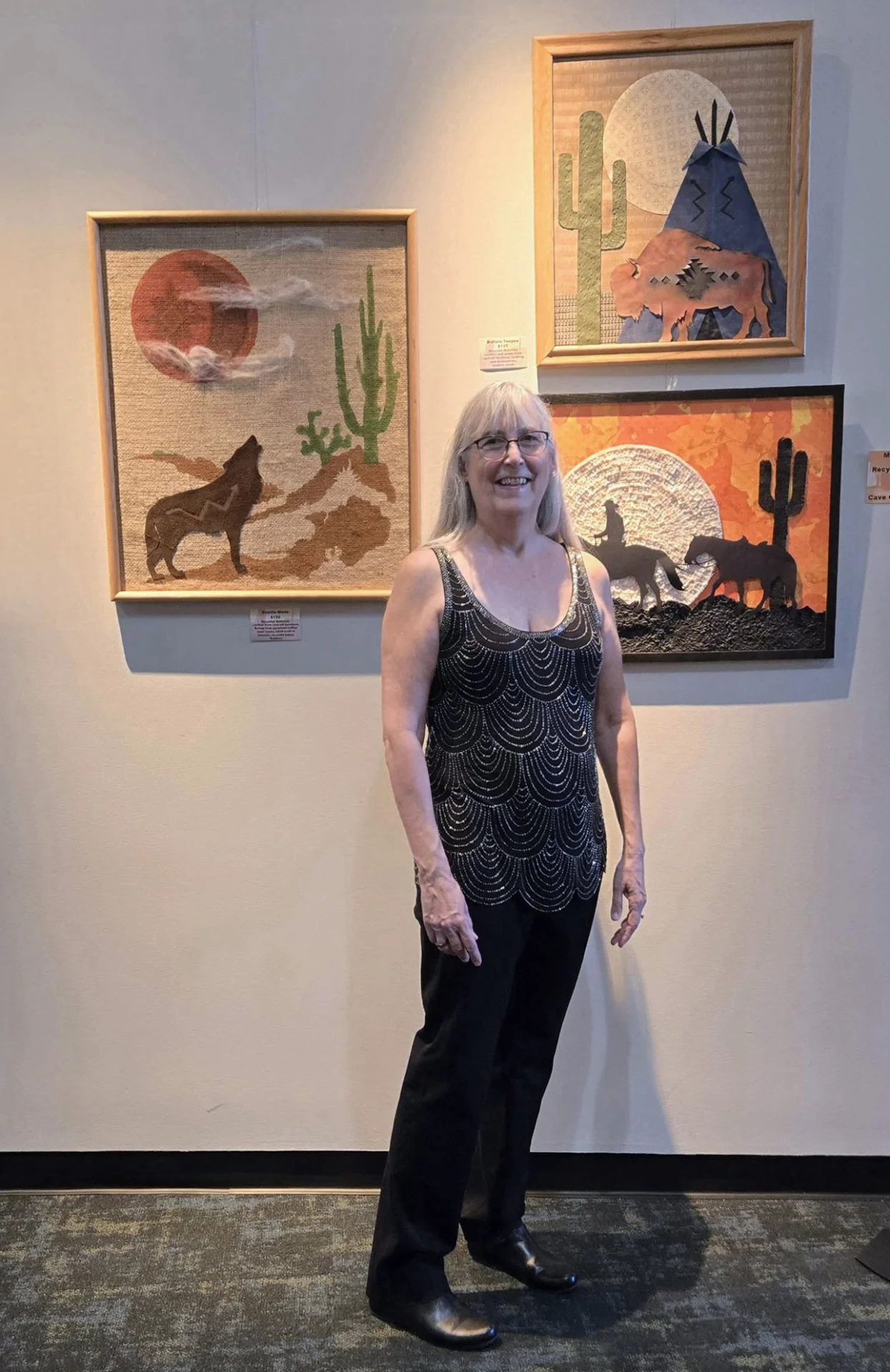
“My artwork takes a very tactile view of our incredible Arizona origins and landscapes,” said Josephine. “I am inspired by the desert views from my Cave Creek backyard and the pine forests of the Mogollon Rim.”
Her work is layered, dimensional, and meant to be experienced as much as seen.
“While I use a variety of materials and processes in each art piece, my methodology focuses on a multimedia layered collage approach with a paper foundation,” she said. “The works contain a variety of different organic materials including hand-crafted paper pulp, repurposed leather, found metalwork, herbs, etc.”
Art you can touch — and stories you can feel
Everything Josephine uses has lived another life. Wool from nuns in Connecticut. Damaged items from Ikea’s “As-Is” section. Upholstery tacks. Ripped paper. Rusted metal. Even an old cabinet door rescued halfway around the world.
“On a trip to China, I went to see a presentation in a tiny village where a man with a homemade distillery was making hooch from dried corn and a pile of wood scraps,” said Josephine.
“I see on the top of the pile a cabinet door and wondered if he was going to burn it. I wanted it. So I asked my tour guide to ask him if I could buy it and he replied that he would trade it for cigarettes.
“So I bought two packs and traded him, and checked the old cabinet door as luggage on my flight back. People thought I was crazy. But now I had a story to tell.”
Those stories matter.
“I’ve become very intentional about moments,” said Josephine.
She also encourages people to experience her art with their hands, not just their eyes. That openness has led to powerful interactions, including a mother once asking if her blind son could touch the pieces.
Josephine loves that her art starts conversations, creates connection, and builds shared experience.
A turning point at The Holland Center
Despite years of creating, Josephine once felt discouraged.
“I had been selling my crafts and art for about 10 years, but the big pieces of art had not been selling and I became discouraged,” she said.
Success at a recycled art festival in Santa Fe gave her renewed confidence — and helped her say “yes” when Jennifer Rosvall encouraged her to display at The Holland Center’s Gallery of Fine Art.
“It was incredible and amazing. It changed my life,” said Josephine. “I’ve never seen my art look like that with the special lighting and the incredible professional display. Items that I had for a while sold immediately, and people came out of the woodwork to my reception to support me. It made me want to do this more.”
The Holland Center didn’t just give her display space. It gave her validation, visibility, and community.
More than art — a place to belong
Getting involved at The Holland Center wasn’t easy at first.
“By nature I’m very shy and introverted, so it was a huge effort to make the decision to get out there and get involved,” said Josephine. “But I’m not unlike any other woman my age who’s retired.”
Before retirement, life was full — but not necessarily personal.
“There was no ‘me’,” she said. “If you asked me what I like to do in my spare time, there was nothing. So when I retired, I had to be proactive and find the things.”
She found them at The Holland Center.
“There’s a lot to like here. I can go from thing, to thing, to thing. For example I can have a show in the gallery, I can volunteer for the Navajo Rug Show, I can teach a class, or I can go to a presentation. The Holland Center is a hub for all of those.”
And she can’t imagine the community without it.
“If The Holland Center didn’t exist, there would be a huge hole, because there’s all these little niches that The Holland Center addresses, and I don’t know where I would go to do any of them because no one else is doing them.”
-----
Josephine once helped organizations recover from disasters.
Now, she helps objects — and sometimes people — find new life.
Through art, through connection, through a place that gave her space to grow, she discovered something many retirees are still searching for: not just something to do, but somewhere to belong.